

The besiegement of York was a formidable undertaking. Situated at the confluence of the River Ouse and the smaller River Foss, the city commanded the only bridges over the Ouse between Selby and Boroughbridge, making encirclement difficult. The Foss had been dammed close to its confluence with the Ouse shortly after the Norman Conquest, causing the river behind to form a large lake, known as the King’s Fishpond, that protected the north-eastern approaches. The city itself was defended by a continuous circuit of Roman and medieval walls built upon an earthen rampart. Although some of its defences had become ruinous by the first half of the 17th century, King Charles ordered that they should be repaired and strengthened during his four-month stay at York in 1642. An outer ring of earthworks and forts was constructed beyond the walls for additional protection and cannon were mounted on the city’s four main gates (or “bars”) and on the castle which dominated the southern defences. The garrison was well supplied with provisions and was fully manned after the arrival of the Marquis of Newcastle’s northern army on 18 April 1644.
The siege of York, 1644
The besieging armies settled around the city in a great arc, with Lord Fairfax’s army to the east, the Scots to the south and west. A bridge of boats was constructed over the River Ouse at Acaster Malbis a few miles south of York to allow communications between the two armies. Initially, the sector to the north between the Ouse and Foss was left open except for occasional patrols. Before the siege could begin in earnest, the Allies had to secure the surrounding country. Stamford Bridge was captured on 24 April but Allied attacks on Cawood Castle were repulsed. Raiders from the Royalist garrison at Pontefract threatened Allied positions to the south of York while Sir Hugh Cholmley sent raiders from Scarborough to harass those to the east. To the north, the Marquis of Montrose and Sir Robert Clavering captured Morpeth Castle, forcing Lord Leven to send troops from the siege to secure his lines of communication with Scotland. But gradually the Allies consolidated their position. Sir John Meldrum finally captured Cawood Castle on 19 May and outposts were established to contain the Royalist raids.
Early in June 1644, the Earl of Manchester arrived at York with the army of the Eastern Association, having secured Lincolnshire for Parliament with the capture of Lincoln and Gainsborough. Manchester’s arrival brought the total number of Allied troops before York to 25,000. The Eastern Association occupied the previously unguarded northern approaches to complete the encirclement of the city. A second bridge of boats was constructed across the Ouse at Poppleton to establish communication between the armies.
Around the same time, Sir Henry Vane arrived with orders from the Committee for Both Kingdoms for the Allied commanders to march against Prince Rupert, who was gathering a Royalist army across the Pennines in Lancashire. The generals were reluctant to split their forces, however, and Vane eventually acknowledged that they were right to continue the siege. During Vane’s conference with the generals, the possibility of deposing King Charles was openly discussed for the first time. The generals unanimously rejected the idea, and it is possible that the Earl of Manchester’s disillusionment with the Parliamentarian cause began as a result of these discussions.
The first Allied artillery battery was established in Lord Fairfax’s sector and began bombarding the walls of York on 5 June. Two days later, the Covenanters stormed three outlying forts that covered the western approach to the city, two of which were captured. This setback prompted the Marquis of Newcastle to open negotiations for surrender. After an exchange of correspondence with the Allied commanders, a cease-fire was arranged for 14 June when commissioners from both sides met to discuss terms. They were unable to reach agreement. The Allied leaders suspected that Newcastle was playing for time and pressed ahead with plans to carry the city by storm.
Realising that the walls of York were too strong to be breached by artillery fire, the Allies initiated mining operations at two points: in the south-east at Walmgate Bar and in the north-west near St Mary’s Tower. They planned to explode the mines and assault the two breaches simultaneously. On 16 June, however, the mine at St Mary’s was exploded prematurely. Major-General Crawford sent 600 Eastern Association infantry through the breach, but the attack was carried out in isolation. The Royalists counter-attacked and secured the breach. The attackers were cut off and forced to surrender before the Allies could support the assault, suffering up to 300 casualties. No further attempts were made to storm the city. Meanwhile, Prince Rupert’s relief force was preparing to lift the siege of York.
Cawood Castle
Address: Thorpe Lane, Cawood, Selby, YO8 3TS
Opening: The castle is not open to the public, but can be let from the Landmark Trust.
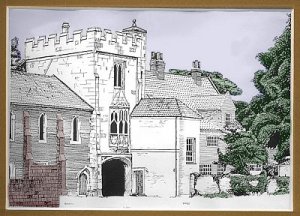
Cawood Castle was a palace for the Archbishop of York, first mentioned in 1181. It was converted into a quadrangular castle from 1374-1388. In 1642, the castle was proclaimed a Royalist stronghold, but in October, Captain Hotham led a force of 500 horse and foot to capture the castle, which was in defiance of a treaty of neutrality between Lord Fairfax and the Yorkshire Royalists.
The Earl of Newcastle resecured York and the surrounding area in December 1642. During the Siege of York, on 24 April 1644, the Parliamentarian attacks on Cawood Castle were repulsed. Finally, Sir John Meldrum’s Parliamentarian forces captured the castle on 19 May, but the Earl of Newcastle briefly recaptured it again in 1644. Shortly after that, Lord Fairfax recaptured it and used it as a prisoner-of-war camp. After the end of the Civil War, the castle was destroyed, with only the gatehouse and the banqueting hall remaining.
Stones from the castle were used to construct the surrounding houses and possibly taken upriver to extend the official residence of the Archbishop of York at Bishopthorpe.
 Cawood History