
The Cawood Sword

Cawood sword

The Cawood Sword
Mystery surrounds this Viking sword which has survived virtually intact for nearly 1,000 years.

Please note: The Yorkshire Museum is home to an extensive and varied collection of items and artefacts. Whilst we make every effort to display a

broad spectrum of our collections it is not always possible for all our collections to be on display at once. Please check the latest exhibitions to find

out what collections are currently on display or contact us on 01904 687687.

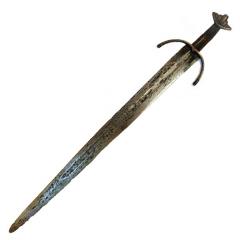
The Cawood Sword is only the fifth sword of its type to be found and is by far the best preserved.

It was discovered in the River Ouse, near Cawood Castle, North Yorkshire, in the late 1800s and its condition is so good that some strange wording

can still be seen along its blade.

There are capital letters from the Roman alphabet on one side and from the Lombardic alphabet on the other, but they do not spell any known words.

Archaeologists believe the words make up a religious phrase to give the sword’s owner extra strength in battle.

The sword dates from 1100, the end of the Viking period and the beginning of the Medieval period, and is very similar to another sword found in

Norway, which has Runes written down its blade, a Viking language.

Mystery also surrounds how the sword ended up in the river. Cawood Castle was the summer palace for the Archbishop of York and in earlier times

was a Viking lord’s manor house.

Overall Length: 36” Blade: 30”
Retail Price: $440.00
$264.95

In Stock!
Blade:
Weight: 2 lb 7 oz
Edge: Sharp
P.O.B.: 4 5/8”
Thickness: 5.3 mm – 3 mm
Width: 49.8 mm
Grip Length: 4 ”
Pommel: Peened
The Hanwei Cawood Sword has a blade of 5160 High Carbon Steel. The guard and pommel are of steel and the grip is overlaid with brown leather.

The hard-core grip is overlaid with brown leather and has a steel throat and chape.

The celebrated Cawood Sword, named after its discovery location near Cawood Castle in England, is regarded as one of the finest and best-

preserved examples of an 11th century Viking sword in existence. Preserved in the mud of the bed of the River Ouse for almost a millenium, the

sword has now found a permanent home in the Yorkshire Museum, where it is a leading attraction. What is almost certainly a sister sword was

unearthed in Norway in 1888, giving a valuable clue to the Cawood Swords origin.
Stephen Cawood son of Robert Cawood Born 1606

Stephen Cawood (son of Robert Cawood and Isabel Jackson)68, 69, 70 was born November 02, 1606 in East Hardwick, England71, 72, and died February 19, 1652/53 in Pointerfract, England73, 74. He married unk on WFT Est. 1625-164775.

Includes NotesNotes for Stephen Cawood:
Notes for STEPHEN CAWOOD I:
Stephen was a yoeman farmer residing in East Hardwick, in the troublous times of James I, Charles I, and
the Commonwealth. The family of Cawoods was, in those times, quite numerous in the neighborhood of
Ackworth, as shown in the registers of St. Cuthbert’s Church, Ackworth, and Stephen Cawood’s will and
the Pontefract Church registers have alone preserved his memory.
By his will, dated January 9, 1653, he left freehold property in East Hardwick, Ackworth, Pontegract,
Hemsworth and Kinsley, to six trustees, in trust, to sell the land in Hemworth and Kinsley, and out of the
money so raised to build a chapel and a free school in East Hardwick. The revenues from the rest of the
Cawood estate were to be devoted to the maintenance of a schoolmaster, to be preaching minister, and to
the relief of the poor in East Hardwick and Ackworth.
Stephen died on February 19, 1653, forty days after the execution of his will.
The trust dating back to 1653, the year he died, and still active in 1985. The endowment had to do with
the erection of the Church of St. Stephen. There was in 1985 a memorial stone slab (3’x6′) laying flat on
the ground next to the fence at the back end of the old Stephen Cawood prorerty, where the original
Chapel was located. the slab bore this inscription:”Near this Place Reseth the Body of Mr. Stephen
Cawood Who was the Founder Both of this Chapel And Free School and Died the 20th Day of Feb. Anno
Domini 1653.” The last ten words have been obliterated from the stone by what appears to have been farm
machinery such as a rotary mower, but the complete insription is on the brass plaque on the wall, inside
the nearby St. Stephen Church.
From parish records, we know he had children. It is possible the establishment of the Trust by Stephen
may have been one reason his son Stephen emigrated to America to seek his fortune.
The trust provides for salary to the Vicar of St. Stephen, education for those needing monetary assistance,
church repairs, and help for the poor of Ackworth and East Hardwick. The income of the Trust is from
real estate originally owned by Stephen Cawood, cash in savings banks, stocks, and a British War Loan.
The Board od Trustees which administers the Trust, meets twice a year and consist of ten persons.
The old schoolhouse and chapel established in East Hardwick are no longer there. In the 19th Century
they reach the point of being beyond repair. They were razed and today two fine modern buildings have
replaced them: A Stephen Cawood Elementary School, and the Church of St. Stephen. Indeed, the name
of Stephen Cawood lives on in the West Riding of Yorkshire.
In 1985 there were no Cawoods living in the Yorkshire village of Cawood or East Hardwick. But the
telephone directories showed them to be scattered throughout the British Isles. There were 167 listings.
There were several listings of businesses and seemingly large corporations. The largest single group (23)
outside England, live in South Africa. These Cawoods undoubtedly have decended from David and Mary
Cawood, who, with their nine children immigrated to South Africa in 1820.
More About Stephen Cawood:
Date born 2: November 02, 160675
Died 2: February 19, 1652/5375

More About Stephen Cawood and unk:
Marriage: WFT Est. 1625-164775

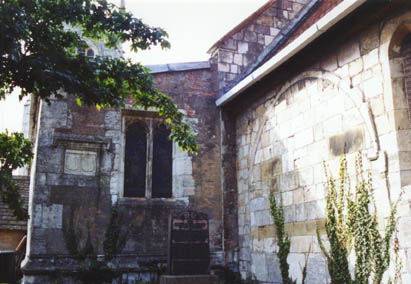
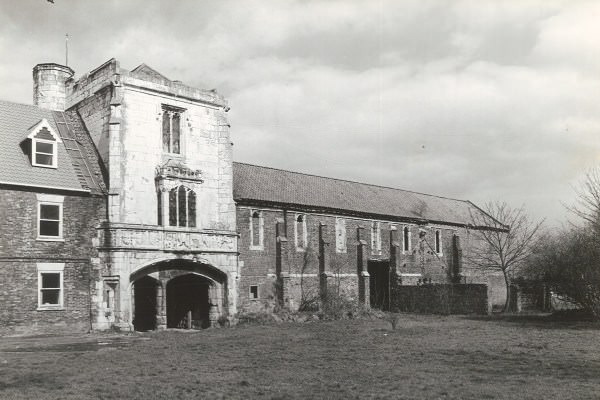
This is where the Cawood family’s private chapel once stood.  The small stone insert on the left memorializes the marriage between the Cawood and Acclom families.

Cawood%20Castle%20Before%20ExteriorChurch6This is where the Cawood family's private chapel once stood. The small stone insert on the left memorializes the marriage between the Cawood and Acclom families.

John Cawood, Queen’s Printer during the reigns of Queen Mary I (1553-1558), and her half-sister, Queen Elizabeth I

John Cawood (son of John Cawood and Elizabeth Folkinham)28, 29 was born 151430, 31, and died 1572 in London, England32, 33. He married Joane Unk in England.

Includes NotesNotes for John Cawood:
Notes for JOHN CAWOOD:
In the latter years of the 15th century, some of the male members of the Cawood family left Yorkshire and
established themselves in London, there to seek their fortunes. One of them, John Cawood became
famous as the Queen’s Printer in the middle of the 16th century. The records states that John Cawood,
Queen’s Printer during the reigns of Queen Mary I (1553-1558), and her half-sister, Queen Elizabeth I
(1558-1603), was a direct descendant of John de Cawood, King Forester, in Yorkshire, and is described as
having arms of the de Cawood of Cawood, near York. According to record, John Cawood was an original
member of the Stationers’ Company, and a bountiful benefactor to them, and was appointed upper warden
in their charter granted by Queen Mary I, and Phillip, 4th May, 1556. He was chosen Master in 1561,
again in 1562, and in 1566. Phillip (King Consort) was king of Spain, and son of Emperor Charles V.
John Cawood exercised the art as Queen’s Printer three or four years before a patent was granted him by
Queen Mary. By the patent John Cawood was constituted Royal Printer and Crown Publisher, and was
granted certain monopolies and privileges.
As Crown Publisher, John Cawood seem to have published all the proclamations of Queen Mary and
Queen Elizabeth. Our Cawood has a photostatic copies of approximately 40 of these. A Bible, sometimes
known as the Cawood Bible, or Queen Elizabeth’s Bible, was printed by John Cawood, Royal Printer.
There are only three copies of the original work known to exist. One can be seen in the Henry Huntington
Library at Pasadena, California, another is in New York Public Library, and the third in the hands of a
private collector in England, whose name we do not know. There are, however, several reproductions
executed by later printers. The printing on the folio of this Bible is a work of art, and a type of work that
accounts for the high reputation John de Cawood held.
In the reign of Queen Elizabeth (1558-1603) John Cawood dwelt in St. Paul’s Churchyard, at the sign of
the “Holy Ghost”, and became partner with Richard Jugge in Queen Elizabeth’s patent.
His epitaph reads, “John Cawood, Citizen and Stationer of London, Printer to the most renowned Queen’s
Majesty, Elizabeth, married three Wives, and had issue by Joane, the first Wife only, as followeth–three
Sons, four Daughters; John his eldest Son being Bachelor of Law, and Fellow in New Colledge in
Oxenford, died 1570. Mary married to George Bischoppe, Stationer; Isabell married to Thomas
Woodcock, Stationer. Gabrael, his second Son, bestowed this dutiful Remembrance of his dear Parents
1591. then Churchwarden. Susanna married to Robert Bullok. Barbara married to Mark Norton. Edmund,
third son, died 1670. “He died 1, of April 1572, be being of Age the 58.”
John Cawood (son of John Cawood and Joane Unk)38, 39 was born Abt. 153440, 41, and died Abt. 157042, 43. He married unk.

Children of John Cawood and unk are:

+Thomas Cawood, b. Abt. 1550, Ackworth, Yorkshire, England44, 45, d. June 10, 1585, Ackworth, Yorkshire, England46, 47.
Thomas Cawood (son of John Cawood and unk)99, 100 was born Abt. 1550 in Ackworth, Yorkshire, England101, 102, and died June 10, 1585 in Ackworth, Yorkshire, England103, 104. He married Mary Jean Willy on September 19, 1574 in Rotherham, County of York England.

More About Thomas Cawood and Mary Jean Willy:
Marriage: September 19, 1574, Rotherham, County of York England.

Children of Thomas Cawood and Mary Jean Willy are:

+Robert Cawood, b. August 21, 1575, Ackworth, Yorkshire, England105, 106, d. June 14, 1610, Ackworth, Yorkshire, England107, 108.

Robert Cawood (son of Thomas Cawood and Mary Jean Willy)56, 57, 58 was born August 21, 1575 in Ackworth, Yorkshire, England59, 60, and died June 14, 1610 in Ackworth, Yorkshire, England61, 62. He married Isabel Jackson on June 14, 1601 in Darrington, County York, England.

More About Robert Cawood:
Date born 2: 157563
Date born 3: August 21, 1575
Died 2: WFT Est. 1609-166663
Died 3: June 14, 1610, York England.

More About Robert Cawood and Isabel Jackson:
Marriage 1: June 14, 1601, Darrington, County York, England.
Marriage 2: June 14, 1601, Darrington, England.63

Children of Robert Cawood and Isabel Jackson are:

+Stephen Cawood, b. November 02, 1606, East Hardwick, England64, 65, d. February 19, 1652/53, Pointerfract, England66, 67.

Family de Cawood

The Family de Cawood, in process of time, rose to become one of the first of the old Yorkshire families. In
1279, during the reign of King Edward I (1272-1307), David de Cawood, son of the heir of Johannes de
Cawood, had the keeper ship of the wood of Langwath. In 1304, the same David de Cawood held 600
acres, a wood and a moor in Cawood. In 1312, he held a third part of the town of Cawood in return for his
service as keeper of the forest of Langwath, between Ouse and Derwent. During this long tenure of office
as Keeper of the Woods, the members of the Cawood family were most liberally rewarded for their service.
The fortunes and position of the family were undoubtedly greatly enhanced by David de Cawood. On the
28th of May, 1263, he was confirmed Abbot of Selby by the King, and ruled that monastery for six years.
Other Cawood’s were prominent in the work of the church: 1279 Thomas de Cawood was Vicar of St.
Felix. In the same year and place Will de Cawood was deacon.
John, son and heir of father David De Cawood, born at Cawood on the day of St. Gregory the Pope. 1294, succeeded his father as keeper of the King’s Forest, and in 1335 held 60 acres of land, with their appurtenances. in Cawood, for Thos service.[caywood.FTW]
The straight line of descent from Johannes de Cawood appears in other early records. This John died in 1390, when he held in Cawood a third part of the town of Cawood and three fishgarths (fish catch or trap) in the river Ouse there and other lands there and in other places. This John was buried in the church of All Saints of Cawood.
By now England entered into a period when the old feudal system had to some extent been destroyed by the rising power of the middle class which it had partialy created. The state of serfdom had decreased with the process of years , and was eventually frustated by the wealthg the people created for themselves by commerce and industry. And so it apears to have happened at Cawood. The archbishop found it necessary to grant properties belonging to the church to certainpeople of the middle class who, in the course of time became landed proprietors, thus raising the importance of the town in which their property was located. History mentions several families as holding land in Cawood and in this connection, states that ” An older family comes before us members of which attained to some distinction, the family De Cawood” It was undoubtedly at this time that John De Cawood became the owner of Cawood castle and all of its appurtenances since,according to the record. “I 1403 John De Cawood held the castle of Cawood and a piscary in the river Ouse.” He married Isabella, and another record states. In 1429, Isabella, who had been the wife of John De Cawood held divers lands in Cawood for service as custodian of the forest between Ouse and Derwent.”

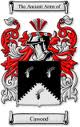
At a relatively early date the Cawood family was granted a coat of arms. These arms are described as follows: CAWOOD—Per Chevron embattled. sable and argent. three harts’ heads caboshed, counterchanged.
In1426, Peter De Cawood was ordered and appointed by the king’s council for the safe conduct of divers hostages of James, king of Scotland, from the tower of London to the city of York and there to deliver them to a Sir Richard Nevyll.
In 1449, Peter, armiger, held in Cawood ond capital messuage, 66 acres of land, 11 acres of meadow, 14 acres of pasture, 12 messuages, 10 toft and a windmill.
Includes NotesNotes for John De Cawood:
Notes for JOHN CAWOOD:
In 1454, John held in Cawood 16 messuages, 14 tofts, 1 windmill, 80 acres of meadowland, and 20 acres
of pasture there. Before this time the office of King’s Chief Forester, had been held by the family of
Cawood for over 300 years.
John Cawood (son of John De Cawood and Agnes Fairfax)18, 19 was born 1475 in Cawood England20, 21, and died 1540 in Cawood, England22, 23. He married Elizabeth Folkinham.Cawood Arms

The beginning of Cawood’s recorded History

Cawood is a word of great antiquity. The first syllable, CA, means hollow, also a field. The last syllable,WOOD, is self evident. It is a place-name of Anglo-Saxon origin, and was first used to describe one who lived in a wooded hollow or field. Cawood, England is our starting place. Cawood appears to have been names for the family Cawood. Cawood is but a half mile from the mouth of the Wharfe River. About the middle of the 11th century, a monk, one Benedict of Auxerre, sailed up the Ouse on his quest to find a suitable place to build a monastery. He came to the vicinity of Cawood, and a short distance away, a place called Selby, built a magnificent Norman Church, in all its majesty and splendor, on what had previously had been a wild waste of marsh and fen-land. He described it as a beautiful place. More than 900 years have passed and beautiful place can still be applied.

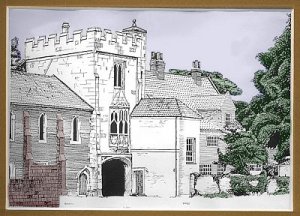
The town of Cawood stands on the south bank of the Ouse. From the ancient records we know a manor house was built during the reign King Asthelstan (924-940) and in the Norman Period it was raised to the dignity of a castle. It was a place of resort for kings and their followings during the war with Scotland.

Since the commencement of the family of Cawood is lost in obscurity, our story starts with Johannes De Cawood, who as early as 1201, in the reign of King John (1199-1216) held by grand Sergeant, one plough land in Cawood and was hereditary Custodian of the Kings Forest between the Ouse and Derwent. Since the office was hereditary, we know the family existed long before that time, perhaps through the reign of William the Conqueror, or earlier. Their office was honorable and lucrative one, for “as forest are of great antiquity, so the care and charge of them was in England always committed to great and honorable personages.”

The obligation held by Johannes De Cawood was directly to the crown, and he was probably not in sympathy with the barons who, in June, 1215, at Runnymede, wrestled from King John the famous instrument known as the Magna Carta. Continuing with our history of the Cawood family, the rule of Archbishop Walter De Gray, (1216-1256) gives us the earliest material in detail. The records show that on the 13th of December, 1227, the Archbishop made the following exchange of land with Johannes De Cawood, Archbishop’s and the King’s Chief Forester—“a member of the family established in gentility in Cawood,” and his heirs: We give him the toft (land suitable for residential location) which belonged to Hugh Noren and William Motte, the toft of Hugh Brand and Peter Carectarius (the cartman), the toft late of Adam Forestarius (the forester), and two undivided portions of open land which we acquired of Willam de Saneta Pace, and a portion called “‘Grescroft” in the west part of “Fleteuro.” He gave us a toft late belonging to John, son of Dreng, a toft late of Adam Parvus (the little), a toft late of Ralph, the son of Roger, and two seylones belonging to the aforesaid toft, and all he had in “Fleteuro.”

From Johannes De Cawood the line of descent continues. According to the record, the hereditary position of King’s Forester continued in the family for over three centuries, and third fact is proof of descent of later Johannes De Cawood of 1201.

The ancient records of the Cawoods were in Latin, and deciphering of many of them turned out to be a chore, requiring many years of patient effort. Many people were unable to read or write, and the priest of the parishes were called upon to do this for them. This included property, deeds etc. A reproduction of a original deed to Johannes De Cawood dated September 14, 1242 follows this page.

The notable family of Cawood remained one of great prominence in the district for over 500 years
The above information came from this site:

http://familytreemaker.genealogy.com/users/c/a/y/Dan-Caywood/WEBSITE-0001/UHP-0017.html

how to enable sharing files