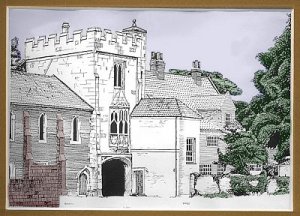

The first record of a de Cawood family in the village of Cawood is in 1201 .
Johannes de Cawood was a King’s Forester in the Ouse and Derwent Forest from Henry lll’s patent rolls in 1200. He had been instructed to walk the the bounds of the forest to mark it out.
In 1066 A year of great importance to all the families of England including the Cawoods who at this time were no doubt involved in the Battle of Fulford. This was the year of Haley’s comet which was visible every night for around three weeks. Many declared it meant bad omens while others said it meant good omens, it just depended on where you were at the time and whose side you were on. Harold of Wessex had taken the crown from his dieing father and left his brother , Tostig out of any inheritance. Tostig went to The Norwegian King Harold and offered him land and richs if he would help him gain the throne. The Vikings landed in the north and marched south down the coast with ships along the coast which turned into the river Ouse at Hull and sailed inland as far as they could with no resistance because the armies of England were waiting for the Normans to invade at the same time under William, later known as the Conqueror. The small village of Cawood lay near Ricall and was a logical crossing place on the Ouse river on the way to the city of york. They built a bridge of boats near the village of Cawood ,which they no doubt pillaged, on their way toward Fulford. In these days the Anglo-saxon men were required to be available for military service for a limited time and I have no doubt that the Cawoods were there. Also there was a Viking sword found in the river Ouse near Cawood which dates to around this time and was probably lost in a fight crossing that bridge of boats at Cawood, of course I am just supposing here but seems logical to assume since no one knows for sure.I have included information about the Cawood Sword in earlier blogs.The Cawood sword was found in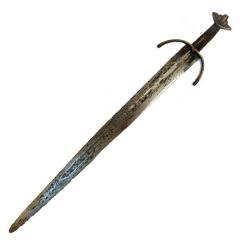 the River Ouse near Cawood in North Yorkshire in the
late 19th century. The blade is of Oakeshott type XII and
has inscriptions on both sides. It most likely dates to the
early 12th century.
The sword is notable as the best-preserved specimen of a
small group of medieval swords with a type M pommel in
the typology of Oakeshott (1964). This type of pommel is
an apparently specifically British derivation of the Viking
Age multi-lobed pommel. It is often found on tomb effigies
of the mid 13th to mid 14th century in southern
Scotland and northern England,[1] but it may have been
in existence since the 11th century.
I have this exerpt from Snorri’s saga;
Snorri’s Saga says:
King Harald lay in the Usa (Ouse). King Harald now went on the land, and drew up his men. The one arm of this line stood at the outer edge of the river, the other turned up towards the land along a ditch; and there was also a morass, deep, broad, and full of water.
The earls let their army proceed slowly down along the ditch, with all their troops in line. The king’s banner was next the river, where the line was thickest. It was thinnest at the ditch, where also the weakest of the men were.
When the earls advanced downwards along the ditch, the arm of the Northmen’s line which was at the ditch gave way; and the Englishmen followed, thinking the Northmen would fly. The banner of Earl Morukare advanced then bravely.
When King Harald saw that the English array had come to the ditch against him, he ordered the charge to be sounded, and urged on his men. He ordered the banner which was called the Land-ravager to be carried before him, and made so severe an assault that all had to give way before it; and there was a great loss among the men of the earls, and they soon broke into flight, some running up the river, some down, and the most leaping into the ditch, which was so filled with dead that the Norsemen could go dry-foot over the fen.
There Earl Morukare fell. Earl Valthiof, (Edwin) and the people who escaped, fled up to the castle of York; and there the greatest loss of men had been.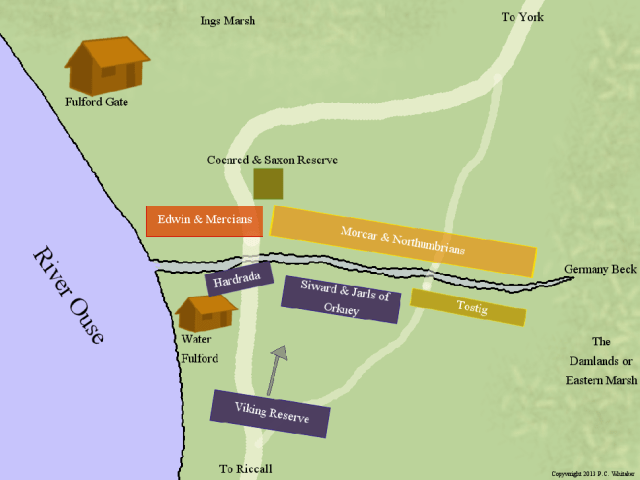
The Battle of Fulford
BY DAVID ROSS, EDITOR
20 September 1066
Fulford, near York, Yorkshire (then capital of Northumbria)
Saxon troops of Mercia and Northumbria, under Earl Edwin and Earl Morcar, respectively vs. a Norse army under King Harald Hardrada, with the aid of Earl Tostig, brother of King Harold Godwinson of England
King Edward the Confessor of England died in 1065. In his place, Harold, Earl of Wessex, took the throne. But the succession was not a smooth one; two other nobles claimed the crown; Harald Hardrada, King of Norway, and William, Duke of Normandy. While William gathered a fleet and waited for favourable winds to sail across the Channel to the south coast of England, Harald gathered an invasion force in the north. The very winds that kept William waiting impatiently in Normandy helped speed Harald’s fleet of longships across the North Sea. To support him he had the exiled brother of King Harold, Earl Tostig.
Harald sailed from Norway to the mouth of the Tyne, where he joined with Tostig. Tostig claimed the Earldom of Northumbria, and was quite ready to support Harald in his invasion in return for help in gaining the Earldom, Together they sacked and burned Scarborough, and sailed up the Humber.
The combined forces of Harald and Tostig must have been formidable; even allowing for exaggeration of their strength in contemporary reports, it seems likely that the invasion force numbered over 10,000 men at arms. By comparison, the Norman army that was victorious at the Battle Hastings, numbered less than 7,000. This comparison may serve to give some idea of just how powerful a threat the Norse army represented.
It seems likely that King Harold, waiting the south, received news of the strong Norse force, and began to march north to meet the threat, even before battle had been joined in the north.
Harald Hardrada landed at Riccall, and marched on the city of York. Harald left a sizeable force of men to guard his fleet, but even so, his army must have numbered over 7,000. They met the defending army, made up of levied troops from Mercia and Northumbria, at Fulford, on the outskirts of York.
The Battle
The terrain around Fulford was flat, but sodden; a mixture of watermeadow and marshland. The Norwegian army advanced along the banks of ditch leading east from the River Ouse. The English attacked the Norwegian line and pushed them back in disarray. But Harald was no fool; he had kept the bulk of his troops back against the river itself, and as the English advanced, Harald’s left wing swept around in an abrupt pincer movement, trapping the English against the ditch.
The fighting was fierce and terrible, but as the day wore on, the English spirit broke, and the armies of Mercia and Northumbria were cut to pieces. Some were trapped against the ditch, others fled, and the bodies of the English lay so plentifully upon the ground that, according to their own accounts, the Norse were able to advance over the meadow without getting their feet wet.
York prudently surrendered to the invaders, and Harald did not enter the city; perhaps eager to spare the city he hoped to rule the effects of looting by his own men. Instead, he retired to Stamford Bridge to await the gathering of hostages from around the region.
The Result
The Norse had but 5 days to enjoy their victory at Fulford. On 25 September, King Harold surprised Harald Hardrada at Stamford Bridge, and inflicted a decisive defeat on the Norsemen. Hardrada himself was killed, as was Tostig, and the Norse withdrew.
During this fight, legend refers to a single Viking berserker who single-handedly defended Stamford Bridge against all odds until stabbed from below the span by a long spear. Though overwhelmed, the rearguard provided Hardrada time to assemble his forces into a line. In addition, he dispatched a runner to summon the rest of his army, led by Eyestein Orre, from Riccall. Pushing across the bridge, Harold’s army reformed and charged the Viking line. A prolonged melee ensued with Hardrada falling after being struck by an arrow.
With Hardrada slain, Tostig continued the fight and was aided by Orre’s reinforcements. As sunset approached, both Tostig and Orre were killed. Lacking a leader the Viking ranks began to waver, and they fled back to their ships.
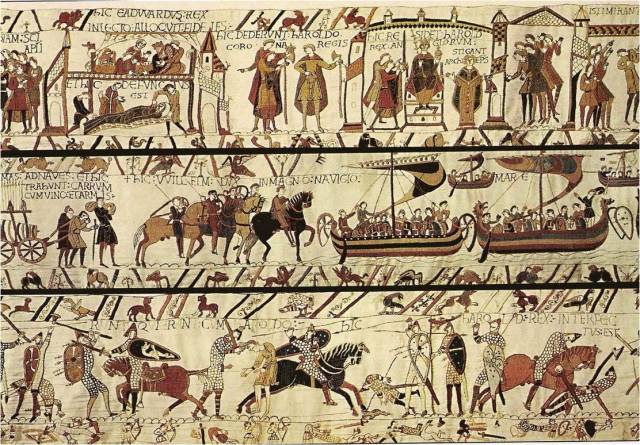
That is not the end of the tale, however, for scarcely had the dust of Stamford Bridge settled when news came of a landing of Norman troops under William of Normandy on the south coast. Harold ordered Morcar and Edwin to gather new levies, while he sped south once more with his exhausted troops. Perhaps unwisely, Harold chose to meet William in battle before the fresh northern troops could arrive. On 14 October, 1066, he met William’s army at Hastings, and there Harold in turn was killed, and the Saxons decisively beaten.
The repercussions of Fulford were enormous. The losses suffered by the Mercian and Northumbrian levies at Fulford meant that the army led by Harold into battle at Hastings was desperately undermanned. It is not a stretch of imagination to claim that the Battle of Fulford led directly to the success of the Norman invasion that followed.


 Cawood History