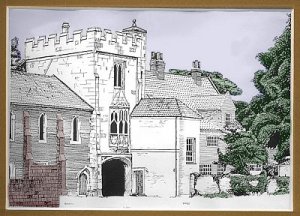

Cawood is a word of great antiquity. The first syllable, CA, means hollow, also a field. The last syllable,WOOD, is self evident. It is a place-name of Anglo-Saxon origin, and was first used to describe one who lived in a wooded hollow or field. Cawood, England is our starting place. Cawood appears to have been names for the family Cawood. Cawood is but a half mile from the mouth of the Wharfe River. About the middle of the 11th century, a monk, one Benedict of Auxerre, sailed up the Ouse on his quest to find a suitable place to build a monastery. He came to the vicinity of Cawood, and a short distance away, a place called Selby, built a magnificent Norman Church, in all its majesty and splendor, on what had previously had been a wild waste of marsh and fen-land. He described it as a beautiful place. More than 900 years have passed and beautiful place can still be applied.
The town of Cawood stands on the south bank of the Ouse. From the ancient records we know a manor house was built during the reign King Asthelstan (924-940) and in the Norman Period it was raised to the dignity of a castle. It was a place of resort for kings and their followings during the war with Scotland.
Since the commencement of the family of Cawood is lost in obscurity, our story starts with Johannes De Cawood, who as early as 1201, in the reign of King John (1199-1216) held by grand Sergeant, one plough land in Cawood and was hereditary Custodian of the Kings Forest between the Ouse and Derwent. Since the office was hereditary, we know the family existed long before that time, perhaps through the reign of William the Conqueror, or earlier. Their office was honorable and lucrative one, for “as forest are of great antiquity, so the care and charge of them was in England always committed to great and honorable personages.”
The obligation held by Johannes De Cawood was directly to the crown, and he was probably not in sympathy with the barons who, in June, 1215, at Runnymede, wrestled from King John the famous instrument known as the Magna Carta. Continuing with our history of the Cawood family, the rule of Archbishop Walter De Gray, (1216-1256) gives us the earliest material in detail. The records show that on the 13th of December, 1227, the Archbishop made the following exchange of land with Johannes De Cawood, Archbishop’s and the King’s Chief Forester—“a member of the family established in gentility in Cawood,” and his heirs: We give him the toft (land suitable for residential location) which belonged to Hugh Noren and William Motte, the toft of Hugh Brand and Peter Carectarius (the cartman), the toft late of Adam Forestarius (the forester), and two undivided portions of open land which we acquired of Willam de Saneta Pace, and a portion called “‘Grescroft” in the west part of “Fleteuro.” He gave us a toft late belonging to John, son of Dreng, a toft late of Adam Parvus (the little), a toft late of Ralph, the son of Roger, and two seylones belonging to the aforesaid toft, and all he had in “Fleteuro.”
From Johannes De Cawood the line of descent continues. According to the record, the hereditary position of King’s Forester continued in the family for over three centuries, and third fact is proof of descent of later Johannes De Cawood of 1201.
The ancient records of the Cawoods were in Latin, and deciphering of many of them turned out to be a chore, requiring many years of patient effort. Many people were unable to read or write, and the priest of the parishes were called upon to do this for them. This included property, deeds etc. A reproduction of a original deed to Johannes De Cawood dated September 14, 1242 follows this page.
The notable family of Cawood remained one of great prominence in the district for over 500 years
The above information came from this site:
http://familytreemaker.genealogy.com/users/c/a/y/Dan-Caywood/WEBSITE-0001/UHP-0017.html
how to enable sharing files
 Cawood History
Hey George. Glad to see your interest in the family. Daughter Sharon has most of our gathering of history.I Seems most of it was after or before the revolution. She loves in Knoxville, would be glad to share.
LikeLike