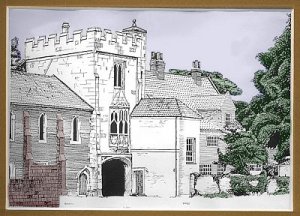

JOHN CAWOOD:
In the latter years of the 15th century, some of the male members of the Cawood family left Yorkshire and
established themselves in London, there to seek their fortunes. One of them, John Cawood became
famous as the Queen’s Printer in the middle of the 16th century. The records states that John Cawood,
Queen’s Printer during the reigns of Queen Mary I (1553-1558), and her half-sister, Queen Elizabeth I
(1558-1603), was a direct descendant of John de Cawood, King Forester, in Yorkshire, and is described as
having arms of the de Cawood of Cawood, near York. According to record, John Cawood was an original
member of the Stationers’ Company, and a bountiful benefactor to them, and was appointed upper warden
in their charter granted by Queen Mary I, and Phillip, 4th May, 1556. He was chosen Master in 1561,
again in 1562, and in 1566. Phillip (King Consort) was king of Spain, and son of Emperor Charles V.
John Cawood exercised the art as Queen’s Printer three or four years before a patent was granted him by
Queen Mary. By the patent John Cawood was constituted Royal Printer and Crown Publisher, and was
granted certain monopolies and privileges.
As Crown Publisher, John Cawood seem to have published all the proclamations of Queen Mary and
Queen Elizabeth. Our Cawood has a photostatic copies of approximately 40 of these. A Bible, sometimes
known as the Cawood Bible, or Queen Elizabeth’s Bible, was printed by John Cawood, Royal Printer.
There are only three copies of the original work known to exist. One can be seen in the Henry Huntington
Library at Pasadena, California, another is in New York Public Library, and the third in the hands of a
private collector in England, whose name we do not know. There are, however, several reproductions
executed by later printers. The printing on the folio of this Bible is a work of art, and a type of work that
accounts for the high reputation John de Cawood held.
In the reign of Queen Elizabeth (1558-1603) John Cawood dwelt in St. Paul’s Churchyard, at the sign of
the “Holy Ghost”, and became partner with Richard Jugge in Queen Elizabeth’s patent.
His epitaph reads, “John Cawood, Citizen and Stationer of London, Printer to the most renowned Queen’s
Majesty, Elizabeth, married three Wives, and had issue by Joane, the first Wife only, as followeth–three
Sons, four Daughters; John his eldest Son being Bachelor of Law, and Fellow in New Colledge in
Oxenford, died 1570. Mary married to George Bischoppe, Stationer; Isabell married to Thomas
Woodcock, Stationer. Gabrael, his second Son, bestowed this dutiful Remembrance of his dear Parents
1591. then Churchwarden. Susanna married to Robert Bullok. Barbara married to Mark Norton. Edmund,
third son, died 1670. “He died 1, of April 1572, be being of Age the 58.” 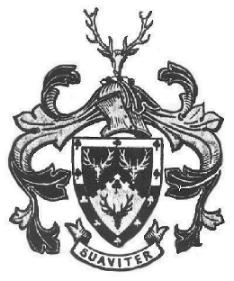
Stephen Cawood American Immigrant and Indentured Servant 1665
STEPHEN CAWOOD II:
Stephen Cawood II was baptised at Pontefract, England May 11, 1630 (in the reign of King Charles I
(1625-49). The Cawoods of Pontefract ans vicinity are the only ones who have been named Stephen. He
emigrated to America evidently in the latter part of 1665, at the time of the Great Plague which,
seemingly, originating in London, spread over practically all of England. At about the same time, in the
latter months of 1665, the Great Fire of London, occurred, when it was said that in London there were
more people dead than remained alive. The fire left many homeless and this, and the plague may have the
reason that prompted Stephen’s departure from England. He also have been may seeking freedom and the
liberty to progress, which they had been denied for so many years.
Stephen Cawood (now 35 years of age) landed in southern Maryland in 1666, probably in the early part of
that year. He came, as many early settlers as an indentured servant, usually for seven years, in order to
repay the ship owner or captain for his transportation fee for having been brought to America.
According to records found in the Land Office, Annapolis, Maryland, Stephen Cawood of Charles County
proved right to 50 acres of land for time of service performed in the province. This record was dated
February 4, 1670-71. On the same day Thomas Dent of St. Mary’s County sold to Stephen Cawood of
Charles County, 200 acres, part of a warrant for 1500 acres granted to Dent July 9, 1670. Warrant was
then issued to Stephen Cawood for 250 acres. Stephen Cawood’s warrant for 250 acres was increased by
200 acres on October 10, 1674, in a transaction by which Charles Calvert (Lord Baltimore) then
Governor, issued to Stephen Cawood warrant for 200 acres, returnable February 10, 1675. On the same
day October 10, 1674, Charles Calvert assigned to Stephen Cawood four persons—Ann Terret, William
Terret, George Blackmore and Katherine Blackmore, who were under obligation to him. Charles Cavert
had apparently sponsored these four parties and paid for their transportation from England. For a certain
consideration, (money or otherwise), these rights passed to Stephan and he was entitled to 50 acres for
each person. Thus the 200 acres from Charles Calvert.
Having acquired additional land by various transactions, Stephen Cawood, who had labored and waited
for several years to find a suitable location, and now married to Ann Terrett, was at last ready to establish
the first home of the Cawoods in the new country. His rights now amounted to 600 acres, and on May 13,
1675, he was granted warrant for that amount. He chose a location lying on the main branch of the
Mattawoman River by a bounded tree of Hull’s land called “Hopewell.” Patent for this tract was issued
May 8, 1676, by Charles Calvert and it was given the name of “Hull.” This plantation has ever since been
known as Hull. It lies about ten miles south of the District of Columbia, about three miles northeast of the
village of Waldorf in Charles County, and about five miles as the crow flies from the point on the Potomac
River lying opposite Mt. Vernon.
One approaches the plantation of Hull from Waldorf. It sets a quarter of mile from the highway. Hull
belonged to the Cawoods down to about 1790. The house has the appearance of once having been
pretentious, but now has lost much of its former glory. It is a large two story building, with a central hall
extending its entire length. Directly back of the house the land drops rapidly to the Mattawoman basin,
giving an amphitheater effect. There are no ancient graves to be found, but there can be no doubt that
according to the customs of the times, many generations of Cawoods lie buried on these ancestral acres.
Through the union of Stephen Cawood and Ann Terrett most, if not all, of the Cawoods descended. There
are cemeteries in Maryland, Virginia, Indiana, Pennsylvania, Ohio, Kentucky and Tennessee where
Cawoods are buried. Name spellings may vary from Caywood, Kawood, Kaywood, Cawode, Kawode etc.,
but the original in English history was Cawood.
Stephen Cawood engaged in the war with the Susquehannock Indians about 1675, and was killed in the
war sometime in 1676, at the age of 46, leaving his wife, Ann Terrett Cawood, and son Stephen. There
may have been other children. He lies buried near where he fell across the Potomac, directly in view of
now Mt. Vernon, home of our first president.
An act for the relief of Ann Cawood, widow, and her children, was introduced in the assembly of
Burgesses and Delegates on May 16, 1676, passed on June, 1676, providing that in consideration of the
great poverty of Ann Cawood, widow and relict of Stephen Cawood ” lately slain in the service and
defense of this province whose death is the occasion of her and her children’s distress” they pay Ann
Cawood for herself and for her children 1500 pounds of tobacco per annum for the next three years. (See
Maryland Archives, Vol II, Page 563.) She seems to be the only one given a pension for his sacrifice. This
may have been one of the very first, if not the first granted in this country. They must have had more than
one child because the pension application mentions children, but we only know of Stephen because he
was old enough (age 14) in 1684 to have witnessed a will.
Immigrant as an *indentured servent to the MD colony; d Abt November 1676, Charles Co., MD killed in a war with indians
Children of Steven Cawood II and Ann Terrett are:
Stephen Cawood III:
STEPHEN CAWOOD III:
Stephen continued to live with his mother and step-father until he was of age. In 1695 he returned to
Charles County to assume possession of his heritage, a plantation of 600 acres, called Hull.
Stephen III made his will September 9, 1735, and it was probated October 15, 1735. He made bequest to
son, John Cawood, part of “Hull”, the balance of “Hull”, to sons William, Thomas, and Stephen Cawood;
he also made bequest to wife, Mary Cawood; to daughters Ann Thomas, Mary Willett, Hester Robinson,
and Penelope Roby; to children of daughter Ann Thomas, by her deceased husband, William Atchison.
Stephen Cawood III died in October of 1735. In his inventory, dated December 19, 1735, are mentioned
six slaves, also a large plantation, which seems to have been well stocked with horses, cattle, and hogs. He
also had a large number of fowl, and various implements, etc, are mentioned. He also had listed many
articles of furniture which had probably been importrd from England and were of the Queen Anne Period,
or some older period.
Mary Cox Cawood, the widow died about March, 1748.
w died about March 1748.
More About Stephen Cawood III:
Date born 2: 167087
More About Stephen Cawood III and Mary Cox:
Marriage: 1690, St Marys Co, MD.87
Children of Stephen Cawood III and Mary Cox are:
+John Cawood, b. 1693, St Marys Co, MD, d. 1769, Berkley,WV.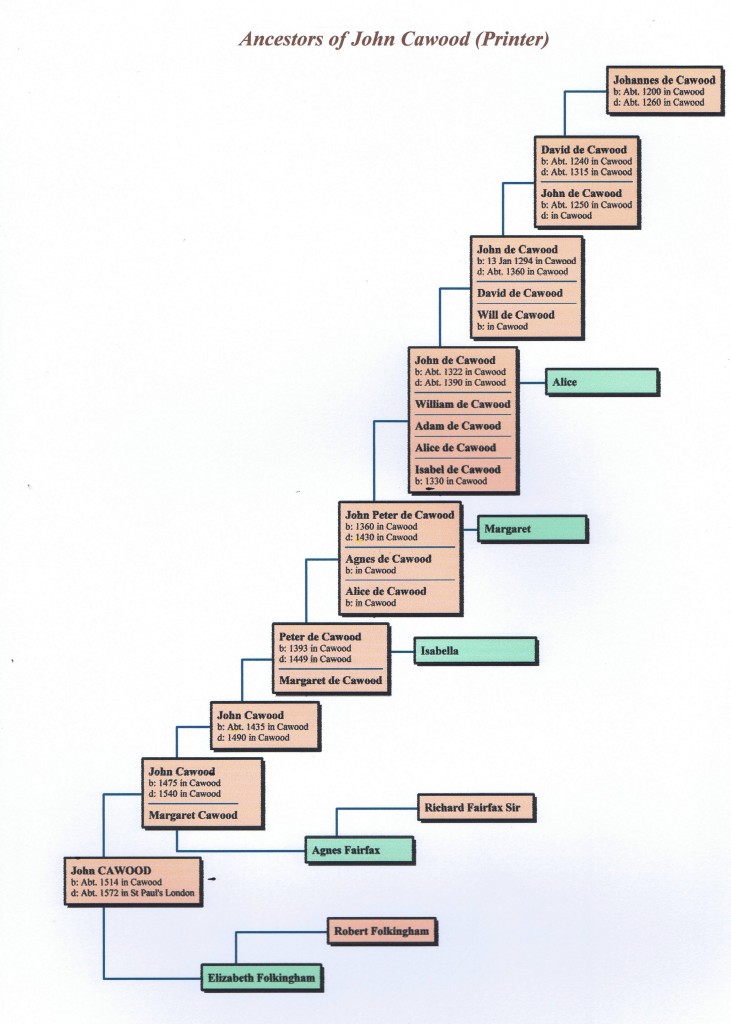

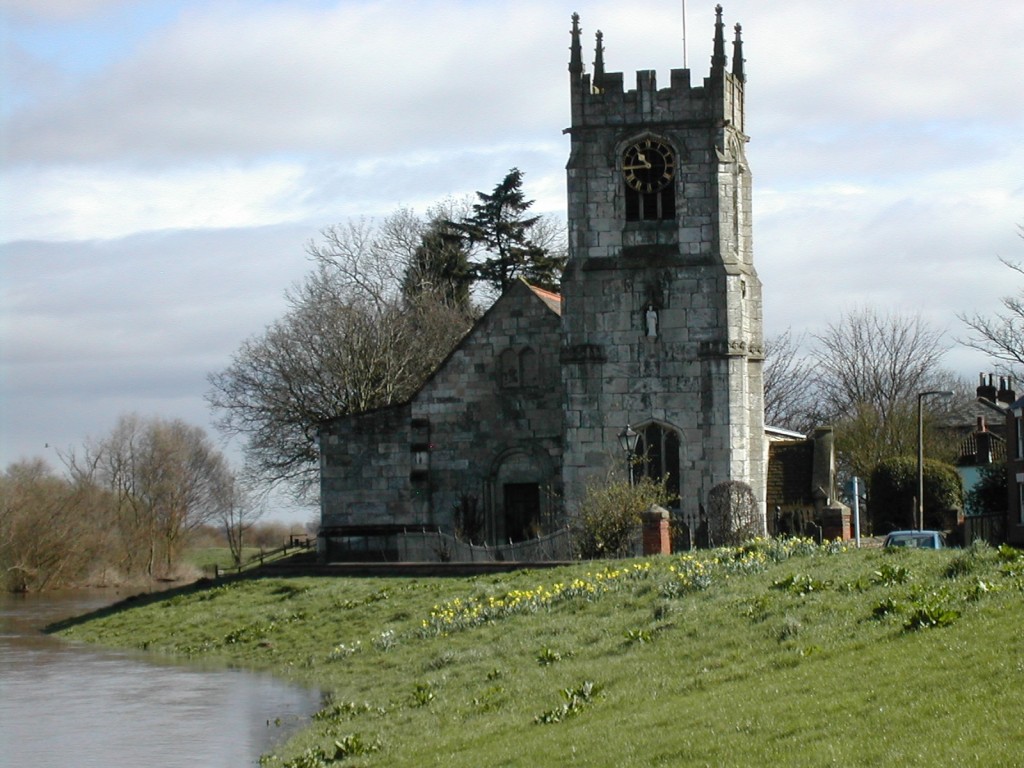
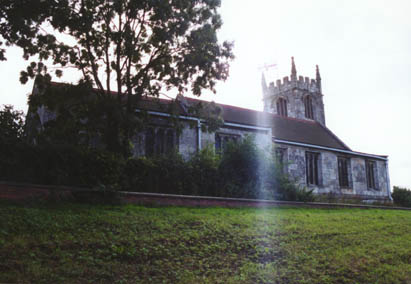
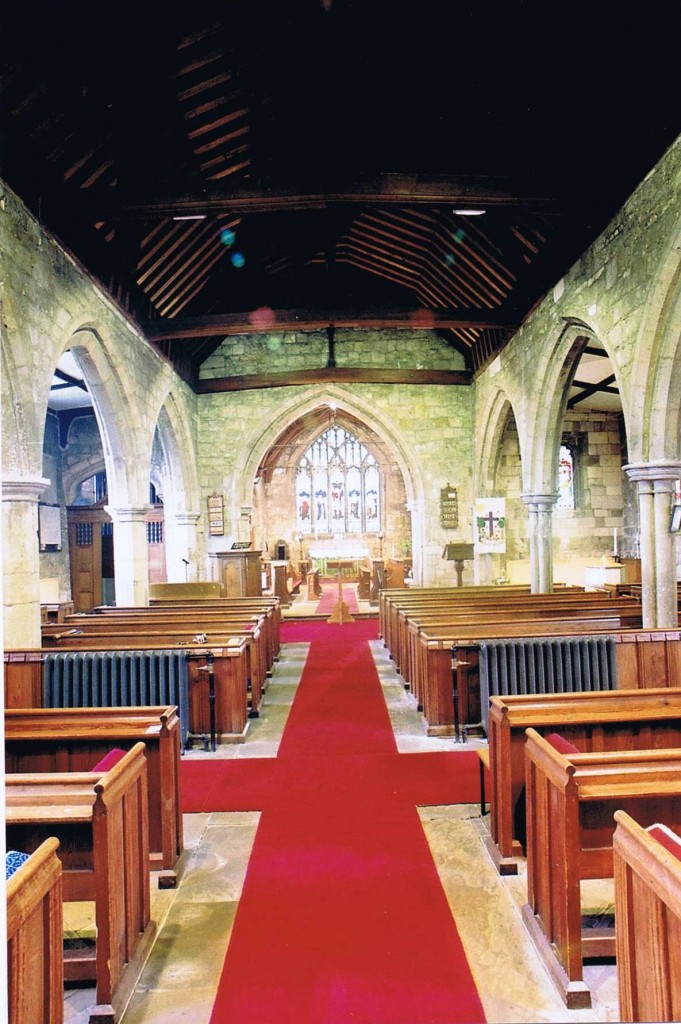
Cawood Castle Garth 2006
Click on this link to learn about the gardens at Cawood Castle.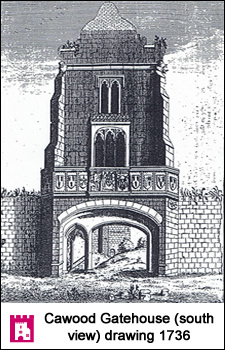
The Cawood Sword
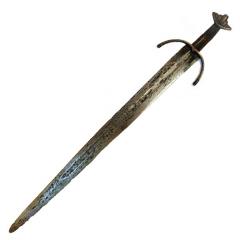
The Cawood Sword
Mystery surrounds this Viking sword which has survived virtually intact for nearly 1,000 years.
Please note: The Yorkshire Museum is home to an extensive and varied collection of items and artefacts. Whilst we make every effort to display a
broad spectrum of our collections it is not always possible for all our collections to be on display at once. Please check the latest exhibitions to find
out what collections are currently on display or contact us on 01904 687687.
The Cawood Sword is only the fifth sword of its type to be found and is by far the best preserved.
It was discovered in the River Ouse, near Cawood Castle, North Yorkshire, in the late 1800s and its condition is so good that some strange wording
can still be seen along its blade.
There are capital letters from the Roman alphabet on one side and from the Lombardic alphabet on the other, but they do not spell any known words.
Archaeologists believe the words make up a religious phrase to give the sword’s owner extra strength in battle.
The sword dates from 1100, the end of the Viking period and the beginning of the Medieval period, and is very similar to another sword found in
Norway, which has Runes written down its blade, a Viking language.
Mystery also surrounds how the sword ended up in the river. Cawood Castle was the summer palace for the Archbishop of York and in earlier times
was a Viking lord’s manor house.
Overall Length: 36” Blade: 30”
Retail Price: $440.00
$264.95
In Stock!
Blade:
Weight: 2 lb 7 oz
Edge: Sharp
P.O.B.: 4 5/8”
Thickness: 5.3 mm – 3 mm
Width: 49.8 mm
Grip Length: 4 ”
Pommel: Peened
The Hanwei Cawood Sword has a blade of 5160 High Carbon Steel. The guard and pommel are of steel and the grip is overlaid with brown leather.
The hard-core grip is overlaid with brown leather and has a steel throat and chape.
The celebrated Cawood Sword, named after its discovery location near Cawood Castle in England, is regarded as one of the finest and best-
preserved examples of an 11th century Viking sword in existence. Preserved in the mud of the bed of the River Ouse for almost a millenium, the
sword has now found a permanent home in the Yorkshire Museum, where it is a leading attraction. What is almost certainly a sister sword was
unearthed in Norway in 1888, giving a valuable clue to the Cawood Swords origin.
Stephen Cawood son of Robert Cawood Born 1606
Stephen Cawood (son of Robert Cawood and Isabel Jackson)68, 69, 70 was born November 02, 1606 in East Hardwick, England71, 72, and died February 19, 1652/53 in Pointerfract, England73, 74. He married unk on WFT Est. 1625-164775.
Includes NotesNotes for Stephen Cawood:
Notes for STEPHEN CAWOOD I:
Stephen was a yoeman farmer residing in East Hardwick, in the troublous times of James I, Charles I, and
the Commonwealth. The family of Cawoods was, in those times, quite numerous in the neighborhood of
Ackworth, as shown in the registers of St. Cuthbert’s Church, Ackworth, and Stephen Cawood’s will and
the Pontefract Church registers have alone preserved his memory.
By his will, dated January 9, 1653, he left freehold property in East Hardwick, Ackworth, Pontegract,
Hemsworth and Kinsley, to six trustees, in trust, to sell the land in Hemworth and Kinsley, and out of the
money so raised to build a chapel and a free school in East Hardwick. The revenues from the rest of the
Cawood estate were to be devoted to the maintenance of a schoolmaster, to be preaching minister, and to
the relief of the poor in East Hardwick and Ackworth.
Stephen died on February 19, 1653, forty days after the execution of his will.
The trust dating back to 1653, the year he died, and still active in 1985. The endowment had to do with
the erection of the Church of St. Stephen. There was in 1985 a memorial stone slab (3’x6′) laying flat on
the ground next to the fence at the back end of the old Stephen Cawood prorerty, where the original
Chapel was located. the slab bore this inscription:”Near this Place Reseth the Body of Mr. Stephen
Cawood Who was the Founder Both of this Chapel And Free School and Died the 20th Day of Feb. Anno
Domini 1653.” The last ten words have been obliterated from the stone by what appears to have been farm
machinery such as a rotary mower, but the complete insription is on the brass plaque on the wall, inside
the nearby St. Stephen Church.
From parish records, we know he had children. It is possible the establishment of the Trust by Stephen
may have been one reason his son Stephen emigrated to America to seek his fortune.
The trust provides for salary to the Vicar of St. Stephen, education for those needing monetary assistance,
church repairs, and help for the poor of Ackworth and East Hardwick. The income of the Trust is from
real estate originally owned by Stephen Cawood, cash in savings banks, stocks, and a British War Loan.
The Board od Trustees which administers the Trust, meets twice a year and consist of ten persons.
The old schoolhouse and chapel established in East Hardwick are no longer there. In the 19th Century
they reach the point of being beyond repair. They were razed and today two fine modern buildings have
replaced them: A Stephen Cawood Elementary School, and the Church of St. Stephen. Indeed, the name
of Stephen Cawood lives on in the West Riding of Yorkshire.
In 1985 there were no Cawoods living in the Yorkshire village of Cawood or East Hardwick. But the
telephone directories showed them to be scattered throughout the British Isles. There were 167 listings.
There were several listings of businesses and seemingly large corporations. The largest single group (23)
outside England, live in South Africa. These Cawoods undoubtedly have decended from David and Mary
Cawood, who, with their nine children immigrated to South Africa in 1820.
More About Stephen Cawood:
Date born 2: November 02, 160675
Died 2: February 19, 1652/5375
More About Stephen Cawood and unk:
Marriage: WFT Est. 1625-164775
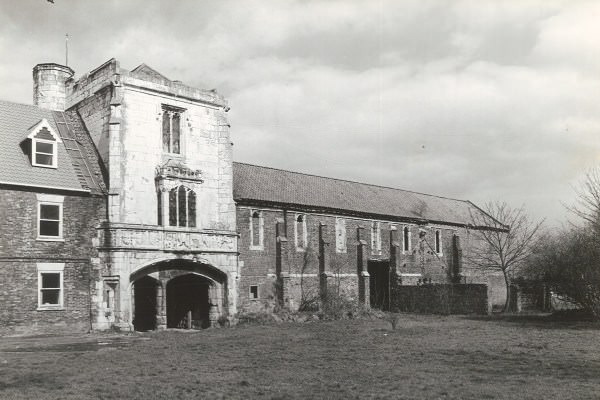
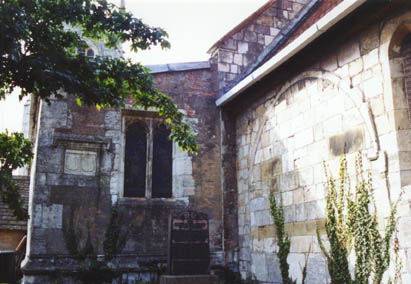
This is where the Cawood family’s private chapel once stood. The small stone insert on the left memorializes the marriage between the Cawood and Acclom families.
John Cawood, Queen’s Printer during the reigns of Queen Mary I (1553-1558), and her half-sister, Queen Elizabeth I
John Cawood (son of John Cawood and Elizabeth Folkinham)28, 29 was born 151430, 31, and died 1572 in London, England32, 33. He married Joane Unk in England.
Includes NotesNotes for John Cawood:
Notes for JOHN CAWOOD:
In the latter years of the 15th century, some of the male members of the Cawood family left Yorkshire and
established themselves in London, there to seek their fortunes. One of them, John Cawood became
famous as the Queen’s Printer in the middle of the 16th century. The records states that John Cawood,
Queen’s Printer during the reigns of Queen Mary I (1553-1558), and her half-sister, Queen Elizabeth I
(1558-1603), was a direct descendant of John de Cawood, King Forester, in Yorkshire, and is described as
having arms of the de Cawood of Cawood, near York. According to record, John Cawood was an original
member of the Stationers’ Company, and a bountiful benefactor to them, and was appointed upper warden
in their charter granted by Queen Mary I, and Phillip, 4th May, 1556. He was chosen Master in 1561,
again in 1562, and in 1566. Phillip (King Consort) was king of Spain, and son of Emperor Charles V.
John Cawood exercised the art as Queen’s Printer three or four years before a patent was granted him by
Queen Mary. By the patent John Cawood was constituted Royal Printer and Crown Publisher, and was
granted certain monopolies and privileges.
As Crown Publisher, John Cawood seem to have published all the proclamations of Queen Mary and
Queen Elizabeth. Our Cawood has a photostatic copies of approximately 40 of these. A Bible, sometimes
known as the Cawood Bible, or Queen Elizabeth’s Bible, was printed by John Cawood, Royal Printer.
There are only three copies of the original work known to exist. One can be seen in the Henry Huntington
Library at Pasadena, California, another is in New York Public Library, and the third in the hands of a
private collector in England, whose name we do not know. There are, however, several reproductions
executed by later printers. The printing on the folio of this Bible is a work of art, and a type of work that
accounts for the high reputation John de Cawood held.
In the reign of Queen Elizabeth (1558-1603) John Cawood dwelt in St. Paul’s Churchyard, at the sign of
the “Holy Ghost”, and became partner with Richard Jugge in Queen Elizabeth’s patent.
His epitaph reads, “John Cawood, Citizen and Stationer of London, Printer to the most renowned Queen’s
Majesty, Elizabeth, married three Wives, and had issue by Joane, the first Wife only, as followeth–three
Sons, four Daughters; John his eldest Son being Bachelor of Law, and Fellow in New Colledge in
Oxenford, died 1570. Mary married to George Bischoppe, Stationer; Isabell married to Thomas
Woodcock, Stationer. Gabrael, his second Son, bestowed this dutiful Remembrance of his dear Parents
1591. then Churchwarden. Susanna married to Robert Bullok. Barbara married to Mark Norton. Edmund,
third son, died 1670. “He died 1, of April 1572, be being of Age the 58.”
John Cawood (son of John Cawood and Joane Unk)38, 39 was born Abt. 153440, 41, and died Abt. 157042, 43. He married unk.
Children of John Cawood and unk are:
+Thomas Cawood, b. Abt. 1550, Ackworth, Yorkshire, England44, 45, d. June 10, 1585, Ackworth, Yorkshire, England46, 47.
Thomas Cawood (son of John Cawood and unk)99, 100 was born Abt. 1550 in Ackworth, Yorkshire, England101, 102, and died June 10, 1585 in Ackworth, Yorkshire, England103, 104. He married Mary Jean Willy on September 19, 1574 in Rotherham, County of York England.
More About Thomas Cawood and Mary Jean Willy:
Marriage: September 19, 1574, Rotherham, County of York England.
Children of Thomas Cawood and Mary Jean Willy are:
+Robert Cawood, b. August 21, 1575, Ackworth, Yorkshire, England105, 106, d. June 14, 1610, Ackworth, Yorkshire, England107, 108.
Robert Cawood (son of Thomas Cawood and Mary Jean Willy)56, 57, 58 was born August 21, 1575 in Ackworth, Yorkshire, England59, 60, and died June 14, 1610 in Ackworth, Yorkshire, England61, 62. He married Isabel Jackson on June 14, 1601 in Darrington, County York, England.
More About Robert Cawood:
Date born 2: 157563
Date born 3: August 21, 1575
Died 2: WFT Est. 1609-166663
Died 3: June 14, 1610, York England.
More About Robert Cawood and Isabel Jackson:
Marriage 1: June 14, 1601, Darrington, County York, England.
Marriage 2: June 14, 1601, Darrington, England.63
Children of Robert Cawood and Isabel Jackson are:
+Stephen Cawood, b. November 02, 1606, East Hardwick, England64, 65, d. February 19, 1652/53, Pointerfract, England66, 67.

 Cawood History